Arquivo da tag: Schiffe der Emigration nach Brasilien

Schiff Cäcilia: Legende & Realität

Schiff Cäcilia: Legende & Realität

(Achtung: mit Google Translator geschrieben!)

Erstausgabe 04/2019 111 Seiten.

capa navio cacilia_190326 v2

Im Jahr 2017 begann ich, das Segelboot Cäcilia zu recherchieren, da ich dachte, dass die Familie Fey an Bord dieses Schiffes vielleicht einer meiner Vorfahren sein könnte.

Am Ende der Recherche bestätigte ich, dass die Fey in Cäcilia aus einer anderen Familie als meiner stammten und veröffentlichte einen Artikel über meine bisherigen Entdeckungen “Die Suche nach dem Cäcilia-Schiff” (klicken Sie auf den Link, um zum kostenlosen Artikel zu gelangen). .

In diesem Monat (04/2019) werden wir ein Buch veröffentlichen, das in gedruckter Form und per E-Book durchsuchbar ist. Es handelt sich dabei um die Legende des Schiffes “Cäcilia”, die eigentlich Helena Maria hieß, die Einwanderer aus Deutschland nach Brasilien brachte.

In diesem Schiff waren ein großer Teil der Passagiere Einwanderer, die in den Staat Rio Grande do Sul und einen kleineren Teil in den Staat São Paulo kamen.

In Rio Grande do Sul ließen sich die Einwanderer hauptsächlich in den heutigen Gemeinden Dois Irmãos und São José do Hortêncio nieder.

Aus einer im Jahr 2017 durchgeführten Umfrage haben wir einen Artikel über das Schiff Cäcilia und jetzt ein Buch darüber erstellt.

Das Buch behandelt Details über die Legende von „Cäcilia“ und die nachgewiesene Realität der Reise in „Helena Maria“.

Im Wesentlichen informiert das Buch über die bibliographischen Untersuchungen des Schiffes Cäcilia, die Untersuchungen zum Nachweis seiner Existenz, den Nachweis, dass das Schiff tatsächlich “Helena Maria” genannt wurde, eine Zusammenfassung mit Angaben zu Schiff, Abfahrts- und Ankunftsort, Datum Abflugs- und Ankunftsort, Passagierliste, Herkunftsort in Deutschland und Niederlassungsort von Einwanderern in Brasilien.

Klicken Sie auf den gewünschten Link, um weitere Daten abzurufen:

Details zur 1. Auflage

Das E-Book umfasst ca. 111 Seiten.

Elektronisches Buch (E-Book) im PDF-Format (A4), nicht bearbeitbar und Drucken nicht zulässig.

Die gedruckte Version wird in Kürze verfügbar sein.

Das E-Book ist individuell und personalisiert (im Auftrag des Käufers), es ist nicht gestattet, ein Darlehen an Dritte weiterzugeben, das heißt für den persönlichen und nicht übertragbaren Gebrauch.

INFORMATIONEN ZUM ERWERB VON BUCH / E-BOOK

  • Kauf in Amazon Version E-Book. Klicken Sie auf diesen Link
  • Kauf eines gedruckten Formatbuches (Brasilien). Klicken Sie auf diesen Link
  • Kauf durchsuchbares E-Book direkt beim Autor (folgen Sie den Anweisungen unten)

ANGABEN ZUM ERWERB DER DIREKTE SUCHBARE E-BOOK-VERSION MIT DEM AUTOR

Wir werden den Kauf des E-Books verfügbar machen, das per Bankeinlage (Bank of Brazil oder Federal Bank) und Zahlungen per Paypal und PagSeguro durchsucht werden kann (wir senden Ihnen eine Benachrichtigung an Ihre E-Mail).

Erwerb: Füllen Sie das Formular dieses Links aus und erwerben Sie die E-Book-Autorversion

Investitionswert und andere Informationen

Der Buchwert in der durchsuchbaren E-Book-Version (Direktverkauf durch den Autor) beträgt R$ 34,99 (reais, brasilianische Währung).

Hinweis: In der Vorstartphase (18/04 bis 18/05) erhalten Teilnehmer deutscher Einwanderungsgruppen in Brasilien einen Rabatt von 50% auf den Kauf der E-Book-Version des Autors.

Die Werte von extern verkauften E-Books / Büchern können je nach Einstellungen von Drittanbietern variieren.

Sie erhalten per E-Mail die Daten für die Zahlung.

Nach der Zahlungsbestätigung erhalten Sie das Buch auch per E-Mail.

Bei Fragen wenden Sie sich bitte an unsere E-Mail (ademar.fey@gmail.com).

Grüße,

Ademar F. Fey

Erforschung der Fey-Familie in Rio Grande do Sul

Erforschung der deutschen Auswanderung nach Rio Grande do Sul und Brasil in der Zeit von 1824 bis 1830

Caxias do Sul, 18.04.2019

Argus Ship – 1824 Year: German Immigration in Brazil

Argus Ship – 1824 Year: German Immigration in Brazil

1st edition 07/2020 85 pages.

navio argus 1824 imigração alema brasil 1a ed versao 5 blog

This book will deal with the ship Argus, which in 1824 brought German immigrants to Brazil, a colony of Nova Friburgo, departing from Germany.

The first edition of this book is available in printed and electronic book format (e-book).

On this ship, a good part of the passengers were immigrants who settled in the German colony of Nova Friburgo and others were allocated in the Imperial army.

After a few years, some settlers migrated internally to the State of Rio Grande do Sul, to the German colony of São Leopoldo.

Basically the book provides a summary with details of the ship, place of departure and arrival, date of departure and arrival, and the list of passengers (as complete as possible, if any), in addition to basic information about immigrants, in most cases .

Check more data by clicking on the link below:

Free summary (first pages of this book)

Details of the 1st edition

The E-book contains approximately 85 pages.

Electronic book (e-book) in PDF (A4) format, not editable and printing not allowed.

The printed version is now available.

The e-book will be individual and personalized (on behalf of the buyer), not being allowed a loan or resale to third parties, that is, for personal and non-transferable use.

INFORMATION FOR ACQUISITION OF THE BOOK / E-BOOK

  • Purchase printed format book (Brazil). Click this link
  • Purchase in Amazon version E-book. Click this link
  • Purchase E-book searchable directly with the author (follow directions below)

INFORMATION FOR ACQUISITION OF THE DIRECT SEARCHED E-BOOK VERSION WITH THE AUTHOR

We will be making available the purchase of the E-book searchable by bank deposit (Bank of Brazil or Federal Bank) and payments via Paypal and PagSeguro (we will send notification to your e-mail).

Acquisition: fill out the form of this link purchase the e-book author version

Investment Value and other information

The value of the book in the searchable e-book version (direct sale by the author) will be R$ 34.99 (Reais – Brasilian Currency).

The values ​​of ebooks / books sold externally may vary depending on third-party settings.

You will receive by email the data to make the payment.

After payment confirmation, you will also receive the book via email.

Any questions please contact our email (ademar.fey@gmail.com).

Regards,

Ademar F. Fey

Researching the Fey family in Rio Grande do Sul

Researching the German emigration to Rio Grande do Sul in the period from 1824 to 1830

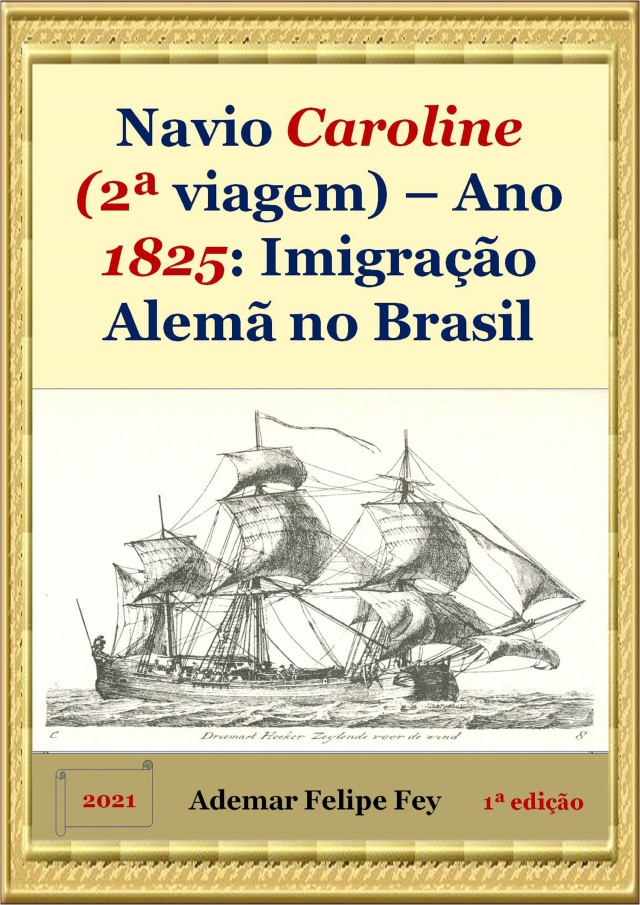
Caroline Ship (2nd voyage) – 1825 Year: German Immigration in Brazil

Caroline Ship (2nd voyage) – 1825 Year: German Immigration in Brazil

1st edition 01/2021 80 pages.

caroline 2a viagem normal v2 cda

1 – Abstract

This book will deal with the ship Caroline, on her second voyage, which in 1825 brought German immigrants to Brazil, mostly to the south of Brazil, departing from Germany.

In it were the ancestors of the book’s author, Conrad Fey (Feyh) and family, and the publication of the book is a tribute to them.

On this ship, a good part of the passengers were immigrants who settled in the German colony of São Leopoldo (RS) and some were allocated to the Imperial army.

Basically the book provides a summary with details of the ship, place of departure and arrival, date of departure and arrival, and the list of passengers (as complete as possible, if any), in addition to basic information about immigrants, in most cases.

Check more data by clicking on the link below:

Free summary (first pages of this book)

2 – Details of the 1st edition

The E-book contains approximately 80 pages.

Electronic book (e-book) in PDF (A4) format, not editable and printing not allowed.

The printed version is now available.

The e-book will be individual and personalized (on behalf of the buyer), not being allowed a loan or resale to third parties, that is, for personal and non-transferable use.

3 – Information for acquisition of the Book/E-book

4 – Purchase Searchable E-book version from the Author (PDF A4 page size).

We will be making available the purchase of the E-book searchable by bank deposit (Bank of Brazil or Federal Bank) and payments via Paypal and PagSeguro (we will send notification to your e-mail).

Acquisition: fill out the form of this link purchase the e-book author version

Investment Value and other information

The value of the book in the searchable e-book version (direct sale by the author) will be R$ 34.99 (Reais – Brasilian Currency).

The values ​​of ebooks / books sold externally may vary depending on third-party settings.

You will receive by email the data to make the payment.

After payment confirmation, you will also receive the book via email.

Any questions please contact our email (ademar.fey@gmail.com).

Regards,

Ademar F. Fey

Researching the Fey family in Rio Grande do Sul

Researching the German emigration to Rio Grande do Sul in the period from 1824 to 1830

Relação de Navios Imigração Alemã no Brasil Anos 1824 a 1830

Relação de Navios Imigração Alemã no Brasil Anos 1824 a 1830

Lista com os navios veleiros que trouxeram imigrantes alemães para o Brasil , nos quais o destino dos imigrantes tenha sido, preferencialmente, o Rio Grande do Sul.

O período abrangido na lista vai de 1824 a 1830 (primeiro período da colonização alemã no Brasil).

A lista dos navios está ordenada por ordem cronológica da chegada no Brasil.

Até o presente momento são em torno de 40 navios localizados e inseridos na lista.

Qualquer informação adicional será bem-vinda!.

Baixe o arquivo gratuito e confira a lista dos navios do período citado (português) neste link

Laden Sie das kostenlose Archiv herunter und sehen Sie sich die Liste der Schiffe des angegebenen Zeitraums an (deutsch)in dieser link

Os dados desta lista dos navios veleiros deste período podem ter sofrido atualizações em nosso livro “Imigração Alemã no Brasil: Navios e Passageiros Anos 1824 a 1830 – 7a ed 2024”

Atte.,

Ademar F. Fey

ademar.fey@gmail.com

Navios Imigração Alemã 1824-1830

Navios Imigração Alemã 1824-1830

Publicado em 22 de fevereiro de 2019 por ademarfey

Lista com os navios veleiros que trouxeram imigrantes alemães para o Brasil , nos quais o destino dos imigrantes tenha sido, preferencialmente, o Rio Grande do Sul.

O período abrangido na lista vai de 1824 a 1830 (primeiro período da colonização alemã no Brasil).

A lista dos navios está ordenada por ordem cronológica da chegada no Brasil.

Até o presente momento são em torno de 40 navios localizados e inseridos na lista.

Qualquer informação adicional será bem-vinda!.

Baixe o arquivo gratuito e confira a lista dos navios do período citado neste link

Os dados desta lista dos navios veleiros deste período podem ter sofrido atualizações em nosso livro “Imigração Alemã no Brasil: Navios e Passageiros Anos 1824 a 1830”

Atte.,

Ademar F. Fey

ademar.fey@gmail.com

Major Georg Anton Schäffer

Major Georg Anton Schäffer

200px-Georg_Anton_Schäffer blog

Personagem que gera muitas interpretações, participou da primeira fase oficial da imigração Alemã no Brasil, principalmente entre os anos 1823 e 1828.

Ganhou do império uma colônia no sul da Bahia, conhecida como colônia Frankental.

No ensaio descrevo maiores detalhes desta colônia e os últimos passos de Schäffer no Brasil.

A ideia é a troca de informações sobre a vida de Schäffer e detalhes relacionados com seus últimos dias de vida.

  • Teria falecido no Brasil ou na Alemanha?
  • Quem eram seus familiares, amigos ou sócios?

Faça o download gratuito do ensaio sobre o Major Schäffer neste link.

Qualquer informação adicional é bem-vinda!

E qualquer dúvida contate por e-mail.

Atenciosamente,

Ademar F. Fey

Pesquisando a imigração alemã no Brasil e Rio Grande do Sul no período de 1824 a 1830

Pesquisando a família Fey no Rio Grande do Sul

A procura pelo navio Cäcilia (Imigração Alemã no RGS)

A procura pelo navio Cäcilia (Imigração Alemã no RGS/Brasil)

The search for the ship Cäcilia (German Immigration in the RGS/Brasil)

Ademar Felipe Fey (*)

RESUMO

A história da emigração alemã para o Brasil é bastante abrangente e possui alguns aspectos ainda não totalmente esclarecidos, principalmente aqueles envolvendo as viagens transatlânticas entre a Alemanha e o Brasil. Nestas viagens marcadas em muitas das vezes, pela fatalidade, a documentação é muito incipiente. Ao pesquisar a origem das famílias Fey que vieram para o Rio Grande do Sul, verificou-se que a história de um dos navios envolvidos, o chamado navio Cäcilia continha relatos históricos que suscitavam dúvidas. Dentro deste contexto, desenvolveu-se a pesquisa bibliográfica envolvendo a viagem do navio citado. Ao longo da exposição deste trabalho pretende-se revelar alguns aspectos e dados da pesquisa, tendo como objetivo possibilitar que futuros pesquisadores possam prosseguir na resolução das dúvidas que ainda restaram sobre a história deste navio, que está enraizada na tradição do município de Dois Irmãos no Rio Grande do Sul, destino de boa parte dos passageiros que estavam no suposto navio chamado de Cäcilia.

PALAVRAS-CHAVE: imigração alemã, navios transatlânticos, navio Cäcilia, primeiro período imigratório da colonização alemã no Brasil, colônia alemã de São Leopoldo no estado do Rio Grande do Sul.

ABSTRACT

The history of German immigration to Brazil is quite comprehensive and has some aspects not yet fully clarified, especially those involving transatlantic travel between Germany and Brazil. In these trips marked in many cases, by fatality, the documentation is very incipient. In investigating the origin of the Fey families that came to Rio Grande do Sul, it was verified that the history of one of the ships involved, called the ship Cäcilia contained historical reports that raised doubts. Within this context, the bibliographical research involving the voyage of the mentioned vessel was developed. The aim of this work is to reveal some aspects and data of the research, aiming to enable future researchers to continue to solve the doubts that remain about the history of this ship, which is rooted in the tradition of the municipality of Dois Irmãos in the Rio Grande do Sul, destination of a good part of the passengers that were in the supposed ship called Cäcilia.

KEY WORDS: German immigration, transatlantic ships, Cäcilia ship, the first immigrant period of German colonization in Brazil, the German colony of São Leopoldo in the state of Rio Grande do Sul.

ABSTRAKT (Google Translator – sorry!)

Die Geschichte der deutschen Einwanderung nach Brasilien ist recht umfassend und weist einige Aspekte auf, die noch nicht vollständig geklärt sind, insbesondere jene, die den transatlantischen Verkehr zwischen Deutschland und Brasilien betreffen. In diesen Reisen, die in vielen Fällen durch den Tod gekennzeichnet sind, ist die Dokumentation sehr am Anfang. Bei der Untersuchung der Herkunft der Fey-Familien, die nach Rio Grande do Sul kamen, wurde bestätigt, dass die Geschichte eines der beteiligten Schiffe, das Schiff Cäcilia, historische Berichte enthielt, die Zweifel aufkommen ließen. In diesem Zusammenhang wurde die bibliographische Untersuchung der Reise des erwähnten Schiffes entwickelt. Das Ziel dieser Arbeit ist es, einige Aspekte und Daten der Forschung zu enthüllen, um zukünftigen Forschern zu ermöglichen, weiterhin die Zweifel an der Geschichte dieses Schiffes zu lösen, die in der Tradition der Gemeinde Dois Irmãos in der Rio Grande do Sul, Ziel eines Großteils der Passagiere, die auf dem angeblichen Schiff Cäcilia waren.

SCHLÜSSELWÖRTER: Deutsche Einwanderung, transatlantische Schiffe, Cäcilia-Schiff, die erste Einwanderungswelle deutscher Kolonisierung in Brasilien, die deutsche Kolonie São Leopoldo im Bundesstaat Rio Grande do Sul.

Download:

(Português) Clique neste link para baixar gratuitamente o artigo A procura pelo navio Cäcilia

(English) Click this link to download for free the article  The search for the Ship Cäcilia

(Deutsch) Klicken Sie auf diesen Link, um den Artikel kostenlos herunterzuladen Die Suche nach dem Schiff Cäcilia (Experimental)

Artigos Imigração Alemã

Artigos sobre Imigração Alemã no Rio Grande do Sul/Brasil

Prezados/as,

abaixo relacionamos os artigos sobre Imigração Alemã que publicamos até o presente momento (clique no artigo desejado para maiores informações e download do arquivo):

Qualquer dúvida ou contribuição entre em contato pelo e-mail ademar.fey@gmail.com

Atenciosamente,

Ademar Felipe Fey

  • Pesquisando a família Fey no Rio Grande do Sul
  • Pesquisando a imigração alemã no Brasil no período de 1824-1830

Contato pelo e-mail ademar.fey@gmail.com

Veleiro Der Kranich (1a viagem) – 1825

Veleiro Der Kranich (1a viagem) – 1825

A primeira família Fey (ancestrais do autor do Blog) que veio para o Rio Grande do Sul viajou pelo navio Der Kranich (1a viagem).

O veleiro saiu de Hamburgo em 25/09/1824 e chegou no Rio de Janeiro 15/01/1825.

Nesta primeria viagem foram transportados 68 colonos e 199 soldados para D. Pedro I.

Faça o download gratuito do arquivo da lista provisória de passageiros desta segunda viagem neste link Lista de Passageiros Provisória Der Kranich (1a viagem) – 1825

Informações mais detalhada do navio e passageiros podem ser encontradas no livro “FEY, Ademar Felipe. Imigração Alemã no Brasil: Navios e Passageiros Anos 1824 e 1825. 5a ed. Caxias do Sul: Edição do Autor, 2024″.

Se você tiver detalhes da viagem e quiser compartilhar conosco entre em contato.

Grato,

Ademar F. Fey

21/07/2017 atualizado em 30/11/2025

Fontes:

FEY, Ademar Felipe. Imigração Alemã no Brasil: Navios e Passageiros Anos 1824 e 1825. 5a ed. Caxias do Sul: Edição do Autor, 2024.

FEY, Ademar Felipe. Imigração Alemã no Brasil: Navios e Passageiros Anos 1824 a 1830. 7a ed. Caxias do Sul: Edição do Autor, 2024.

HUNSCHE, Carlos. O Biênio 1824/25 da Imigração e Colonização Alemã no Rio Grande do Sul (Província de São Pedro). 2a ed. Porto Alegre: A Nação/IEL, 1975.

TRESPACH, Rodrigo. Lista de Passageiros do navio Navio Der Kranich, viagem de 1824-25. Disponível em: http://www.rodrigotrespach.com. Acesso em 21/07/2017.

Você está autorizado a usar o material desta página desde que cite a fonte.

Schiff Cäcilia: Mythos/Legende oder Wirklichkeit?

Schiff Cäcilia: Mythos/Legende oder Wirklichkeit?

(German version – Google translator – sorry for any mistake)

In der Studie der deutschen Einwanderung in Rio Grande do Sul/ Brasilien fanden wir von 1824 bis 1840 mehr als 40 Schiffe (Fey).

Unter diesen Schiffen sticht eine Geschichte hervor: die Reise des Schiffes Cäcilia.

Die Fahrt des Schiffes hat in 2017 190 Jahre geworden.

Nach den örtlichen Schriftstellern, die mit der deutschen Auswanderung verbunden waren, verließ das Schiff Cäcilia im Januar 1827 Bremen oder Hamburg mit einer katastrophalen Reise.

Das Schiff hätte während eines Sturms in der Nordsee, England, zwischen dem 12. und 13. Januar dieses Jahres schwere Schäden erlitten.

Das Schiff hätte alle drei Masten verloren und nach einiger Zeit von einem englischen Booten gerettet und in den Hafen von Plymouth oder Falmouth geschleppt, in England.

Mit kleinen Variationen wurde diese Geschichte seit 1924 in mehreren Webseiten und Büchern repliziert, als Vater Amstad sein Buch zum Gedenken an das hundertjährige deutsche Einwanderungsamt in Rio Grande do Sul veröffentlichte.

Von hier aus kamen mehrere Versionen der Reise.

Für einige Schriftsteller verließ das Schiff Bremen für andere aus Hamburg.

In der Version einiger Schriftsteller wurde das Schiff nach Plymouth geschleppt und zweitens zum Hafen von Falmouth.

Immer noch fragen Sie das Datum der Abreise: für einige wäre es im Jahre 1827 und für andere im Jahre 1828.

Vor kurzem erschien eine neue Version, wo es heißt, dass in Wirklichkeit dieses Schiff nicht existiert und der Name wurde geändert, aus irgendeinem unbekannten Grund.

Es ist sicher, dass viele der schiffbrüchigen Seeleute dieses Schiffes, ob sie existierten oder nicht, 1829 nach Brasilien an Bord des James Laing Ship kam (siehe Liste der Passagiere auf der entsprechenden Seite auf der Blog-Homepage).

Diese Blog-Seite versucht, Informationen über diese Reise zu verbreiten, die die deutsche Einwanderung in Rio Grande do Sul markiert hat.

Laden Sie den kostenlosen Artikel über das Schiff Cäcilia in diesen link hoch artigo veleiro Cäcilia

Im Juni 2018 wurde bestätigt, dass das Schiff im Januar 1828 aus Holland segelte und sein Name eigentlich “Helena Maria” war.

In Anbetracht dieser Neuigkeiten habe ich im April 2019 ein Buch über dieses Segelboot veröffentlicht (weitere Details unter dem Link “Sailboat Cäcilia”).

Wenn Sie sich über Berichte von Einwanderern oder Nachkommen bewusst sind, die diese Reise gemacht haben und sich freuen möchten, kontaktieren Sie uns bitte (siehe “Kontakt” -Seite unseres Blogs).

Dankbar!

Ademar F. Fey
Caxias do Sul, 25. Juli 2017

Quellen:

  • FEY, Ademar Felipe. Imigração Alemã no Brasil: Navios e Passageiros Anos 1824 a 1830. Caxias do Sul: Ademar Felipe Fey, 2018.
  • HUETTENBERGER. Heimlich nach Brasilien (A forgotten Palatine emigration to Brazil). Disponível em: <http://www.huettenberger.homepage.t-online.de/FR.htm>. Acesso em 15/05/2017.
  • HUNSCHE, Carlos e ASTOLFI, Maria. O Quadriênio 1827-1830 da Imigração e Colonização Alemã no Rio Grande do Sul. Porto Alegre: Editora GxW, 2004.
  • ROSA, Gilson Justino da. Imigrantes Alemães (1824-1853). Est: Porto Alegre, 2005.
  • PADRE AMSTAD. Cem Anos de Germanidade no Rio Grande do Sul. Unisinos, São Leopoldo, 1924.
  • FAMÍLIA GAUER. História da Família Gauer.Disponível em: <http://www.familiagauer.com.br/historia_imigracao.htm>. Acesso em 15/05/2017.
  • PAROQUIA MARTIN LUTHER. Imigração No RS e no Brasil. Disponível em: <http://www.mluther.org.br/Imigracao/imigracao.htm>. Acesso em: 15/05/2017.
  • MUNICÍPIO DE DOIS IRMÃOS/RS. História do Município de Dois Irmãos. Disponível em: <http://www.doisirmaos.rs.gov.br/doisirmaos/historia>. Acesso em: 15/05/2017.

Die Verwendung der Daten auf dieser Seite kann erfolgen, sofern die Quelle angegeben ist.

Ursprünglich am 25.07.2017 veröffentlicht.

Letzte Aktualisierung: 06.05.2019.