Arquivo da categoria: ships of German emigration to Brazil.

Buch Schiff Actif – Jahr 1828: Deutsche Einwanderung in Brasilien 1. Auflage 2022

Buch Schiff Actif – Jahr 1828: Deutsche Einwanderung in Brasilien 1. Auflage 2022

(Achtung: mit Google Translator geschrieben!)

1. Auflage 03/2022 171 Seiten.

1 – Zusammenfassung

Dieses Buch befasst sich mit dem Schiff Actif, das 1828 von Deutschland aus deutsche Einwanderer nach Brasilien brachte, hauptsächlich in den Bundesstaat Pernambuco (zunächst).

Darin befanden sich größtenteils die Einwanderer, die zu den Pionieren der Kolonie Santa Amélia (Catucá) am Rande der Stadt Recife wurden.

Der Text des Buches, einschließlich des Reiseverlaufs dieses Schiffes, basiert auf historischen Dokumenten und schildert so getreu wie möglich die Schwierigkeiten, denen sich die Pioniere der deutschen Einwanderung bei der Reise und dem Lebensunterhalt auf brasilianischem Boden gegenübersahen.

Nach Meinung des Autors ist es eine der unglaublichsten Geschichten der deutschen Einwanderung nach Brasilien in der Zeit von 1824 bis 1830.

Im Wesentlichen bietet das Buch eine Zusammenfassung mit Angaben zum Schiff, Abfahrts- und Ankunftsort, Abfahrts- und Ankunftsdatum, einige Korrekturen zu den Passagieren, die mit diesem Schiff gekommen sind, und der Passagierliste (so vollständig wie möglich), sowie grundlegende Informationen über die Einwanderer, sofern verfügbar, und eine Zusammenfassung der Kolonie Santa Amélia, basierend auf Dokumenten aus der Zeit.

Überprüfen Sie weitere Daten, indem Sie auf den folgenden Link klicken:

Kostenlose Zusammenfassung (erste Seiten dieses Buches)
Video mit Buchpräsentation (klicken Sie auf diesen Link)
Actif book erratum (klicken Sie auf diesen Link) Demnächst

2 – Angaben zur 1. Auflage

Das E-Book umfasst ca. 171 Seiten.

Elektronisches Buch (E-Book) im PDF-Format (A4), nicht editierbar und Ausdruck nicht erlaubt.

Die gedruckte Version ist ab sofort verfügbar.

Das E-Book wird individuell und personalisiert (im Auftrag des Käufers) und darf nicht an Dritte verliehen oder weiterverkauft werden, dh für den persönlichen und nicht übertragbaren Gebrauch.

3 – INFORMATIONEN ZUM ERWERB VON BUCH / E-BOOK

4 – ANGABEN ZUM ERWERB DER DIREKTE SUCHBARE E-BOOK-VERSION MIT DEM AUTOR

Wir werden den Kauf des E-Books verfügbar machen, das per Bankeinlage (Bank of Brazil oder Federal Bank) und Zahlungen per Paypal und PagSeguro durchsucht werden kann (wir senden Ihnen eine Benachrichtigung an Ihre E-Mail).

Erwerb: Füllen Sie das Formular dieses Links aus und erwerben Sie die E-Book-Autorversion

Investitionswert und andere Informationen

Der Buchwert in der durchsuchbaren E-Book-Version (Direktverkauf durch den Autor) beträgt R$ 34,99 (Reais – Brasilianische Währung).

Die Werte von extern verkauften E-Books / Büchern können je nach Einstellungen von Drittanbietern variieren.

Sie erhalten per E-Mail die Daten für die Zahlung.

Nach der Zahlungsbestätigung erhalten Sie das Buch auch per E-Mail.

5 – zusätzliche Information

Bei Fragen wenden Sie sich bitte an unsere E-Mail (ademar.fey@gmail.com).

Grüße,

Ademar F. Fey

Erforschung der Fey-Familie in Rio Grande do Sul

Erforschung der deutschen Auswanderung nach Rio Grande do Sul in der Zeit von 1824 bis 1830

Deutsche Auswanderung nach Brasilien 1824-1972

Deutsche Auswanderung nach Brasilien

Es wird geschätzt, dass zwischen den Jahren 1824 und 1972 etwa 200.000 Einwanderer (diese Zahl ist kein Konsens unter Historikern und kann je nach konsultierter Quelle stark variieren) aus verschiedenen Teilen Germaniens nach Brasilien kamen, insbesondere in den Südosten und Süden dieses Landes.

Zwar gab es schon vor 1824 Versuche, mit deutschen Einwanderern im Süden des Staates Bahia Kolonien zu gründen, diese sind jedoch nicht ausreichend dokumentiert.

Hier auf dieser Seite finden Sie Informationen zur ersten Phase der Auswanderung aus dem ehemaligen Deutschland nach Brasilien (1824 bis 1830).

Zum jetzigen Zeitpunkt wird geschätzt, dass 10.000 deutschsprachige Einwanderer aus verschiedenen Königreichen und Ländern nach Brasilien kamen (darunter Siedler, Soldaten und Handwerker).

(Wählen Sie das gewünschte Element im Hauptrahmen oben auf dem Bildschirm aus)

42 Schiffe liefen von verschiedenen europäischen Häfen aus und fuhren vor allem nach Rio de Janeiro. Von dort folgten sie mit kleineren Booten in die Provinzen, wo sie neuen Kolonien zugeteilt wurden.

Während dieser Zeit sind mehrere Artikel und Bücher (im Ausland auf Amazon suchen nach Ademar Felipe Fey) erhältlich.

Nachfolgend listen wir die verfügbaren Bücher auf:

I – nach Zeitraum

II – Mit dem Schiff

III – Von der Familie

Im Zweifelsfall nehmen Sie bitte Kontakt mit uns auf (Portugiesisch, Englisch und Deutsch) per E-mail ademar.fey@gmail.com.

Grüße,

Ademar Felipe Fey – dezember 2021

aktualisiert am 19.06.2024

ademar.fey@gmail.com

Navio Ativo (Actif)

Navio Ativo (Actif)

O veleiro Ativo (Activo/Active/Actif) partiu do porto de Amsterdã em abril de 1828 e chegou ao litoral do nordeste do país em agosto de 1828.

O Ativo era um navio veleiro tipo brigue de dois mastros e transportou cerca de 140 imigrantes.

Realizou a trigésima segunda (32a.) viagem com imigrantes alemães ao Brasil no período de 1824 a 1830 (Fey).

Os imigrantes estavam destinados ao sul do país e por motivos não determinados desviou-se seu rumo ao nordeste.

Depois de 1 ano após a chegada, os imigrantes se estabeleceram na colônia Santa Amélia, cerca de uns 20 km do centro da cidade do Recife/Pernambuco.

Após alguns anos a colônia deixou de existir e os imigrantes se dispersaram na cidade de Recife e nas demais colônias, especialmente no Rio Grande do Sul.

A lista original de passageiros deste navio é desconhecida.

O autor Hunsche cita os seguintes sobrenomes:

Bister, Cardel, Christiani, Ecker, Grunert, Heil, Hister, Kaspar, Kirsch, Klein, Kneip, Kraemer, Leidner, Link, Mohr, Morschaiser (Morschäuser), Mossmann, Mundtruck, Sauer, Scher(er), Schmitz, Seiber, Steffens, Stein, Tech. Weingaertner, Welter, Wershein, Windhaiser (Windhäuser) e Woll.

Em 2020 iniciamos uma pesquisa visando esclarecer esta viagem e descobrir a relação de passageiros.

Consulte os sites nas fontes citadas para ter acesso a maiores informações.

Em 2023 publicamos um livro específico sobre este navio. Consulte no link Navio Actif

Qualquer informação adicional sobre os imigrantes e este navio é bem-vinda (ademar.fey@gmail.com).

Fontes:

Postado em 21/09/2021 por Ademar Felipe Fey

Última atualização: 21/09/2021.

Você está autorizado a usar o material desta página desde que cite a fonte.

Errata do Livro/E-book Navio Johanna Jacoba – ano 1828: Imigração Alemã no Brasil 1a edição 2021

Errata do Livro/E-book Navio Johanna Jacoba – ano 1828: Imigração Alemã no Brasil 1a edição 2021

Errata (o número de página pode mudar um pouco em função das diferentes formatações do livro):

  1. Capítulo 3 (COMPROVAÇÃO DA PASSAGEM DOS IMIGRANTES PELA HOLANDA E PARTIDA DO PORTO DE  AMSTERDÃ).
    Considere a seguinte informação correta sobre o imigrante Johann Adam Wershhein na Carta nº 1 Página nº 1 (p. 54): “…. Johann Adam Wershheim com sua esposa e 6 filhos
  2. Capítulo 3 (COMPROVAÇÃO DA PASSAGEM DOS IMIGRANTES PELA HOLANDA E PARTIDA DO PORTO DE  AMSTERDÃ).
    Considere a seguinte informação correta sobre o imigrante Johannes Scherer na Carta nº 1 Página nº 1 (p. 54): “…. Johannes Scherer com sua esposa e 4 filhos
  3. Capítulo 4 (Relação de Passageiros).
    Os imigrantes Magdalena Adam(s), Johann Menderich (Münderich?) e Jacob Zingsheim muito provavelmente não estavam no navio Johanna Jacoba (dezembro de 2021).
  4. Capítulo 4 (Relação de Passageiros).
    A família Junglaus/Junklaus/Junkes está sendo revista. Surgiram dados conflitantes sobre o local de origem e nomes dos imigrantes e datas de nascimento.

Para maiores informações sobre o livro/e-book clique link abaixo:

Livro “ Navio Johanna Jacoba – ano 1828: Imigração Alemã no Brasil 1a edição 2021

Atenciosamente,

Ademar F. Fey

02/08/2021

Atualização em 02/08/2021

Projeto 2021 – Imigração Alemão no Brasil – Parte 2

Projeto 2021 – Imigração Alemão no Brasil – Parte 2

No ano de 2020 homenageamos dois estados brasileiros lançando dois livros sobre os navios que trouxeram os primeiros imigrantes para as cidades de Nova Friburgo no Rio de Janeiro (Navio Argus) e Rio Negro no Paraná (Navio Charlotte & Louise).

Em 2021 lançamos os livros do Navio Caroline (2a viagem) e Navio Johanna Jacoba, cujos passageiros foram para as colônias de São Leopoldo (RS) e São Pedro de Alcântara (SC), respectivamente.

Veja maiores detalhes no link livros homenagem aos estados

Agora para 2021 (parte 2) pretendemos publicar um livro que traga informações importantes sobre os primeiros imigrantes que vieram para o Estado de Pernambuco (Colônia de Santa Amélia) no navio Ativo.

Para tanto estamos buscando ajuda de descendentes que possam trazer informações sobre relatos da viagem destes primeiros imigrantes e relações de parentesco entre as famílias daqueles imigrantes (cidade de origem, parentesco, para onde foram, componentes da família de imigrantes, etc.).

Para auxiliar, elaboramos uma relação dos sobrenomes sobre os quais estamos buscando as informações acima destacadas.

Relação dos Imigrantes (estimados) que chegaram em 1828 em Pernambuco, segundo Hunsche (Quadriênio):

Bister, Cardel, Christiani, Ecker, Grunert, Heil, Hister, Kaspar, Kirsch, Kein, Kneip, Kraemer, Leidner, Link, Mohr, Morschaiser (Morschäuser), Mossmann, Mundtruck, Sauer, Scher(er), Schmitz, Seiber, Steffens, Stein, Tech, Weingaertner, Welter, Wershein, Windhaiser (Windhäuser) e Woll.

Atenção: boa parte destas famílias se mudou para outros estados, principalmente para o Rio Grande do sul e, talvez, Santa Catarina (não se descarta outros estados) entre 1828-1838.

No início de 2022 estamos concluindo as pesquisas sobre esta leva.

Famílias que não se encontraram maiores informações:

ADAMS, Magdalena;
KLEIN, Johann;
KRAEMER, Mathias;
MENDERICH, Johann;
MORSCHAISER, Adam;
WERSHHEIN, Johann Adam;
ZIMMER, Johannes.      

Agradecemos qualquer informação sobre estas famílias (informe pelo e-mail ademar.fey@gmail.com).

Livro Navio Johanna Jacoba – Ano 1828: Imigração Alemã no Brasil 1a edição 2021

Livro Navio Johanna Jacoba – Ano 1828: Imigração Alemã no Brasil 1a ed 2021

1a edição 07/2021 atualização 06/2024 150 páginas (16×23).

1 – Resumo

Este livro tratará do navio Johanna Jacoba, que no ano de 1828 trouxe imigrantes alemães para o Brasil, em sua maioria para o sul do Brasil, partindo da Alemanha.

Nele, em sua maioria, estavam os pioneiros da colônia de São Pedro de Alcântara,no estado de Santa Catarina.

O livro confirma a lista de passageiros e também a sua partida da Holanda.

Basicamente o livro informa um resumo com detalhes do navio, local de saída e chegada, data de saída e chegada, algumas correções sobre os passageiros que vieram neste navio e a lista de passageiros (a mais completa possível), além de informações básicas sobre os imigrantes, sempre que disponíveis.

Confira mais dados, clicando no link abaixo:


2 – Detalhes da 1a edição

O livro contem aproximadamente 150 páginas e será vendido no formato de livro impresso e e-book.

A versão impressa (tamanho de página padrão 16×23) pode ser solicitada na Brasil e no exterior (veja detalhes mais abaixo).

A versão de livro eletrônico (e-book), no formato PDF (16×23), é pesquisável, não editável e a impressão não é permitida (será individual e personalizada em nome do comprador, não sendo permitido empréstimo e nem revenda a terceiros, ou seja, para uso pessoal e intransferível).

3 – Informações para aquisição do livro

4 Compra E-book pesquisável versão do Autor (PDF página tamanho 16×23).

Valor do livro digital (versão do autor pesquisável): R$ 49,99.

Estaremos disponibilizando a compra do E-book pesquisável por depósito bancário (Banco do Brasil ou Caixa Federal) ou PIX, no formulário abaixoPara pagamento via Paypal e PagSeguro entre em contato com nosso e-mail ademar.fey@gmail.com)

Preencha o Formulário para Compra do e-book versão autor

5 – Informações Adicionais

Qualquer dúvida favor contatar nosso e-mail (ademar.fey@gmail.com).

If you have any questions, please contact us via email (ademar.fey@gmail.com).

Bei Fragen kontaktieren Sie uns bitte per E-Mail (ademar.fey@gmail.com)

Atenciosamente,

Ademar F. Fey

Pesquisando a família Fey no Rio Grande do Sul

Pesquisando a emigração Alemã para o Brasil no período de 1824 a 1830

Projeto 2021 – Imigração Alemão no Brasil – Parte 1

No ano de 2020 homenageamos dois estados brasileiros lançando dois livros sobre os navios que trouxeram os primeiros imigrantes para as cidades de Nova Friburgo no Rio de Janeiro (Navio Argus) e de Rio Negro no Paraná (Navio Charlotte & Louise). Veja maiores detalhes no link livros homenagem aos estados

Agora para 2021 pretendemos publicar um livro que traga informações importantes sobre os primeiros imigrantes que vieram para o Estado de Santa Catarina (Colônia de São Pedro de Alcântara).

Para tanto estamos buscando ajuda de descendentes que possam trazer informações sobre relatos da viagem destes primeiros imigrantes e relações de parentesco entre as famílias daqueles imigrantes (cidade de origem, parentesco, para onde foram, componentes da família de imigrantes, etc.).

Para auxiliar, elaboramos uma relação dos sobrenomes sobre os quais estamos buscando as informações acima destacadas.

Relação dos Imigrantes que chegaram em 1828 para Santa Catarina baixe o documento neste link

Com satisfação anunciamos que o livro sobre o Navio Johanna Jacoba – ano 1828: Imigração Alemã no Brasil foi lançado, abordando o nosso tema deste projeto 2021 parte I (clique no link para conferir as informações). Parte I do projeto 2021 concluída. Veja aqui a parte II.

Confira os sobrenomes e nos informe qualquer informação pertinente pelo e-mail abaixo ademar.fey@gmail.com.

Ship Cäcilia: Legend & Reality

Ship Cäcilia: Legend & Reality

Initial release 04/2019 111 pages.

capa navio cacilia_190326 v2

In 2017 I started researching the Cäcilia sailboat thinking that maybe the Fey family aboard this ship could be one of my ancestors.

At the end of the research I confirmed that the Fey in Cäcilia were from a family other than mine and published an article reporting what I had discovered so far “The search for the Cäcilia ship” (click on the link to access the free article).

This month (04/2019) we will launch a book in print and e-book searchable, involving the legend of the ship “Cäcilia”, which was actually called Helena Maria, who brought immigrants to Brazil from Germany.

In this ship, a good part of the passengers were immigrants who came to the state of Rio Grande do Sul and a smaller part to the state of São Paulo.

In Rio Grande do Sul, immigrants settled mainly in the present municipalities of Dois Irmãos and São José do Hortêncio.

From a survey conducted in 2017, we have produced an article on the ship Cäcilia and now a book on it.

The book deals with details about the legend of “Cäcilia” and the proven reality of the journey in “Helena Maria”.

Basically the book informs the bibliographic research on the ship Cäcilia, the research carried out to prove its existence, the proof that the ship was actually called “Helena Maria”, a summary with details of the ship, place of departure and arrival, the date of departure and arrival, the passenger list, the place of origin in Germany and the place of establishment of immigrants in Brazil.

Check out more data by clicking on the desired link:

Details of the 1st edition

The E-book contains approximately 111 pages.

Electronic book (e-book) in PDF (A4) format, not editable and printing not allowed.

The printed version will be available shortly.

The e-book will be individual and personalized (on behalf of the buyer), not being allowed a loan or resale to third parties, that is, for personal and non-transferable use.

INFORMATION FOR ACQUISITION OF THE BOOK / E-BOOK (four options)

  • Purchase in Amazon version E-book. Click this link
  • Purchase printed format book (Brazil). Click this link
  • Purchase E-book searchable directly with the author (follow directions below)

INFORMATION FOR ACQUISITION OF THE DIRECT SEARCHED E-BOOK VERSION WITH THE AUTHOR

We will be making available the purchase of the E-book searchable by bank deposit (Bank of Brazil or Federal Bank) and payments via Paypal and PagSeguro (we will send notification to your e-mail).

Acquisition: fill out the form of this link purchase the e-book author version

Investment Value and other information

The value of the book in the searchable e-book version (direct sale by the author) will be R$ 34,99 (Reais, Brazilian currency).

Note: In the pre-launch phase (18/04 to 18/05) participants of German Immigration Groups in Brazil will have a 50% discount on the purchase of the e-book version of the author.

The values ​​of ebooks / books sold externally may vary depending on third-party settings.

You will receive by email the data to make the payment.

After payment confirmation, you will also receive the book via email.

Any questions please contact our email (ademar.fey@gmail.com).

Regards,

Ademar F. Fey

Researching the Fey family in Rio Grande do Sul

Researching the German emigration to Rio Grande do Sul and Brasil in the period from 1824 to 1830

Caxias do Sul, 04/18/2019

Argus Ship – 1824 Year: German Immigration in Brazil

Argus Ship – 1824 Year: German Immigration in Brazil

1st edition 07/2020 85 pages.

navio argus 1824 imigração alema brasil 1a ed versao 5 blog

This book will deal with the ship Argus, which in 1824 brought German immigrants to Brazil, a colony of Nova Friburgo, departing from Germany.

The first edition of this book is available in printed and electronic book format (e-book).

On this ship, a good part of the passengers were immigrants who settled in the German colony of Nova Friburgo and others were allocated in the Imperial army.

After a few years, some settlers migrated internally to the State of Rio Grande do Sul, to the German colony of São Leopoldo.

Basically the book provides a summary with details of the ship, place of departure and arrival, date of departure and arrival, and the list of passengers (as complete as possible, if any), in addition to basic information about immigrants, in most cases .

Check more data by clicking on the link below:

Free summary (first pages of this book)

Details of the 1st edition

The E-book contains approximately 85 pages.

Electronic book (e-book) in PDF (A4) format, not editable and printing not allowed.

The printed version is now available.

The e-book will be individual and personalized (on behalf of the buyer), not being allowed a loan or resale to third parties, that is, for personal and non-transferable use.

INFORMATION FOR ACQUISITION OF THE BOOK / E-BOOK

  • Purchase printed format book (Brazil). Click this link
  • Purchase in Amazon version E-book. Click this link
  • Purchase E-book searchable directly with the author (follow directions below)

INFORMATION FOR ACQUISITION OF THE DIRECT SEARCHED E-BOOK VERSION WITH THE AUTHOR

We will be making available the purchase of the E-book searchable by bank deposit (Bank of Brazil or Federal Bank) and payments via Paypal and PagSeguro (we will send notification to your e-mail).

Acquisition: fill out the form of this link purchase the e-book author version

Investment Value and other information

The value of the book in the searchable e-book version (direct sale by the author) will be R$ 34.99 (Reais – Brasilian Currency).

The values ​​of ebooks / books sold externally may vary depending on third-party settings.

You will receive by email the data to make the payment.

After payment confirmation, you will also receive the book via email.

Any questions please contact our email (ademar.fey@gmail.com).

Regards,

Ademar F. Fey

Researching the Fey family in Rio Grande do Sul

Researching the German emigration to Rio Grande do Sul in the period from 1824 to 1830

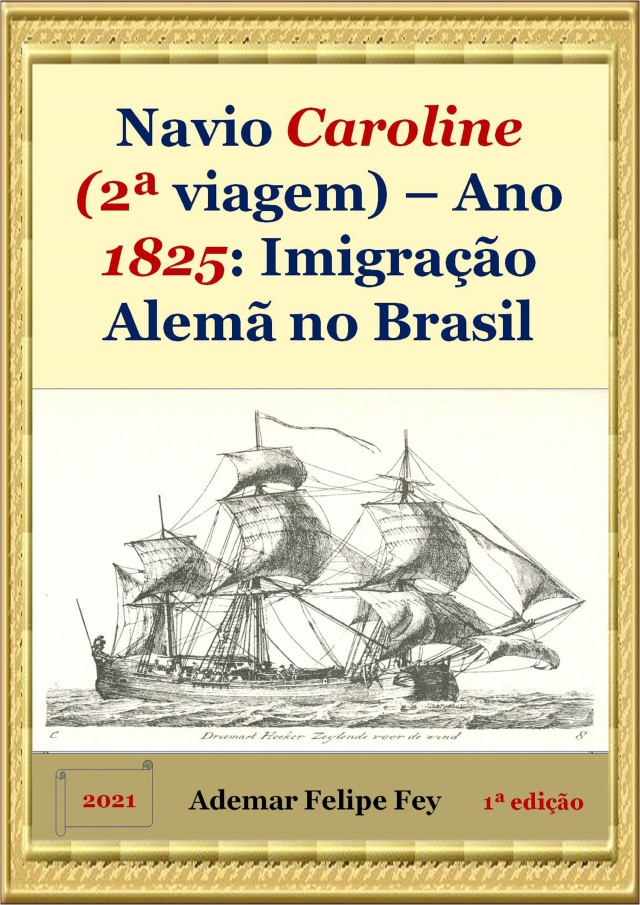
Caroline Ship (2nd voyage) – 1825 Year: German Immigration in Brazil

Caroline Ship (2nd voyage) – 1825 Year: German Immigration in Brazil

1st edition 01/2021 80 pages.

caroline 2a viagem normal v2 cda

1 – Abstract

This book will deal with the ship Caroline, on her second voyage, which in 1825 brought German immigrants to Brazil, mostly to the south of Brazil, departing from Germany.

In it were the ancestors of the book’s author, Conrad Fey (Feyh) and family, and the publication of the book is a tribute to them.

On this ship, a good part of the passengers were immigrants who settled in the German colony of São Leopoldo (RS) and some were allocated to the Imperial army.

Basically the book provides a summary with details of the ship, place of departure and arrival, date of departure and arrival, and the list of passengers (as complete as possible, if any), in addition to basic information about immigrants, in most cases.

Check more data by clicking on the link below:

Free summary (first pages of this book)

2 – Details of the 1st edition

The E-book contains approximately 80 pages.

Electronic book (e-book) in PDF (A4) format, not editable and printing not allowed.

The printed version is now available.

The e-book will be individual and personalized (on behalf of the buyer), not being allowed a loan or resale to third parties, that is, for personal and non-transferable use.

3 – Information for acquisition of the Book/E-book

4 – Purchase Searchable E-book version from the Author (PDF A4 page size).

We will be making available the purchase of the E-book searchable by bank deposit (Bank of Brazil or Federal Bank) and payments via Paypal and PagSeguro (we will send notification to your e-mail).

Acquisition: fill out the form of this link purchase the e-book author version

Investment Value and other information

The value of the book in the searchable e-book version (direct sale by the author) will be R$ 34.99 (Reais – Brasilian Currency).

The values ​​of ebooks / books sold externally may vary depending on third-party settings.

You will receive by email the data to make the payment.

After payment confirmation, you will also receive the book via email.

Any questions please contact our email (ademar.fey@gmail.com).

Regards,

Ademar F. Fey

Researching the Fey family in Rio Grande do Sul

Researching the German emigration to Rio Grande do Sul in the period from 1824 to 1830